Black Water
The Curse of Boontjieskraal

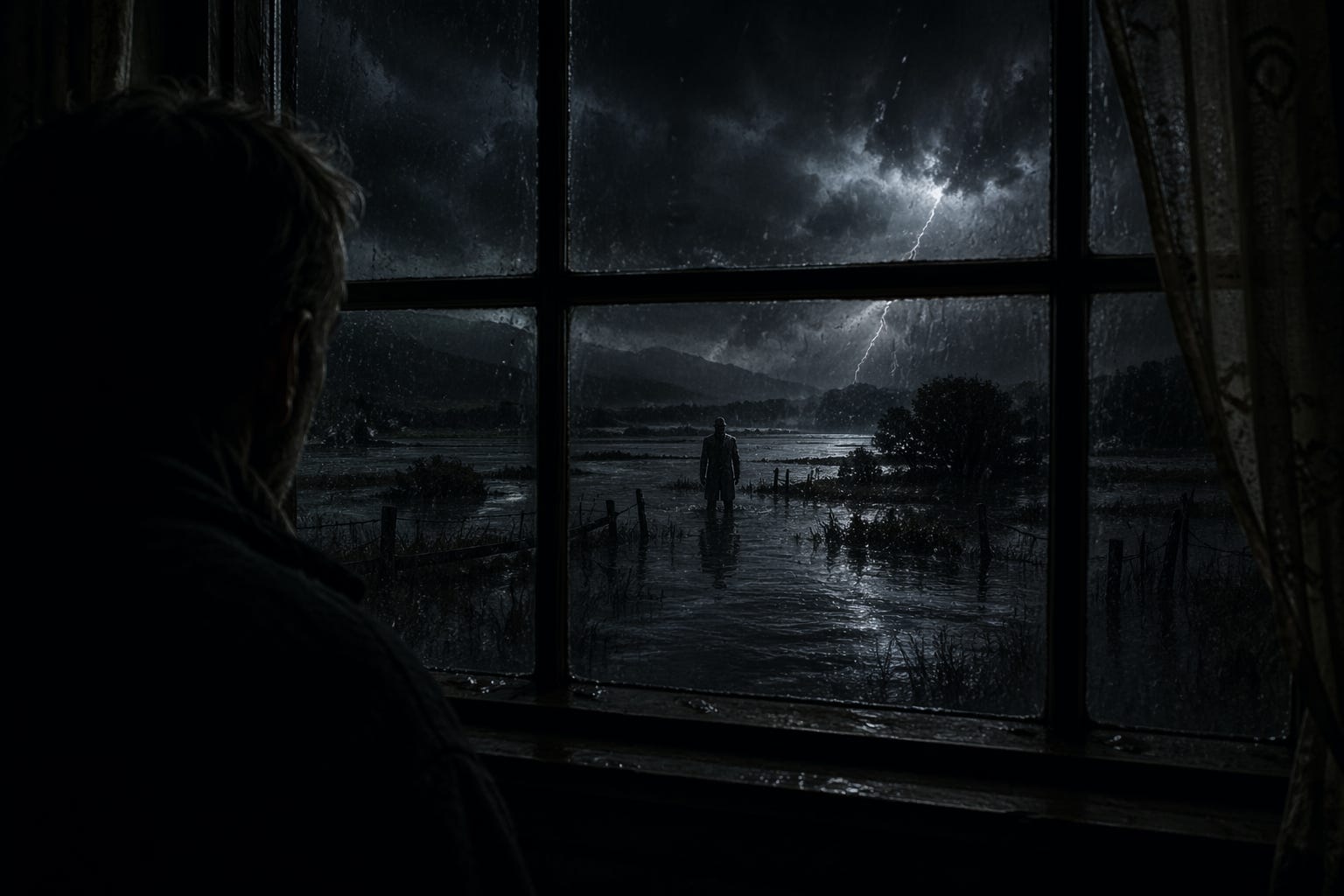
This story is told in the Overberg, where the land stretches wide beneath an open sky, and the silence can feel as deep as the earth itself. The rivers there do not always look dangerous. Most days they move slowly, quietly, as if they belong to the land. But when the rain comes down from the mountains, they change. They rise without warning. They take what stands too close. And sometimes… they leave something behind.
The fire burned low that night, its glow soft and uneven as it settled into the dark. The smell of smoke drifted through the air, mixing with the dry scent of grass and dust. We were a group of students, sitting close together in a loose circle, closer than we had earlier, though no one spoke about it. It had happened slowly, without thought, as if something in the night had drawn us inward.
Even the wind seemed to move differently. It passed through the grass in long, slow waves, brushing against it with a soft, dragging sound that did not quite feel like wind alone. More than once, I found myself turning slightly, certain I had heard something just beyond the edge of the firelight. But every time, there was nothing there. Only darkness.
I do not remember seeing him arrive. There was no sound. No footsteps. No movement in the grass.
One moment, the space across the fire was empty, and the next, he was there.
At first, I thought he had been sitting there all along, unnoticed somehow. But that feeling did not last. There was something wrong with that thought, something that did not settle properly in the mind.
His clothes were old, worn thin in places, and they hung heavily on him. It took a moment before I understood why.
They were wet.
Not damp from the night air, but soaked through, darkened as if he had walked through heavy rain. And yet, the ground around him was dry.
No one spoke. No one asked who he was.
It was not fear, not at first. It was something quieter. Something that made the question feel… unwelcome. As if asking it would disturb something that should not be touched.
He did not look at us. Not once. His gaze rested on the fire, fixed on the slow-moving flames, as though they held his attention completely. His face did not change. His eyes did not shift. He sat as if he had been there for a very long time, waiting for something to begin.
When he finally spoke, his voice was low and calm. It did not rise above the night, yet somehow it carried further than it should have. It seemed to settle into the space around us, filling the quiet instead of breaking it.
“This place…” he said slowly, as if the words were being chosen with care, “Boontjieskraal… is a place where the river runs close to the land.”
The wind moved softly past us, and I felt a faint chill brush across my arms.
“Most days,” he continued, “it looks quiet. Peaceful. Like nothing there could ever harm you. But water…”
He paused, his eyes still fixed on the fire.
“…water does not forget what it is.”
Something in the way he said it made my chest feel tight.
“When the rain comes down from the mountains, the river rises. It does not wait. It does not warn. And when it rises…”
He leaned forward, just slightly.
“…it takes.”
For a moment, I thought I heard it. Not the wind, not the grass—but something deeper. A low, distant movement, like water far away in the dark.
“There was a farm beside that river,” he went on. “The farmer believed he understood the land. He trusted what he could see. He believed that what stood before him was all there was. And he believed his house would protect him from anything beyond it.”
The fire shifted, and sparks lifted slowly into the air before disappearing into the night.
“One evening, the sky darkened too early. The light faded while there was still time left in the day. The color drained from the world, leaving behind something dull and heavy, like a bruise spreading across the sky. The air thickened. It pressed against the chest with every breath.”
I swallowed without realizing it.
“And then the rain came.”
He did not rush the words.
“It came all at once. Hard. Relentless. The ground could not take it. Water spread across the fields, moving faster than it should have. And the river… began to rise.”
The sound of the fire seemed louder now, each crack sharp against the silence.
“That same evening, a man came to the farm.”
I felt my hands tighten in my lap.
“He was not alone. His wife and child walked beside him. They had tried to cross the river, but the water rose too quickly. It cut them off. Behind them, the storm closed in. There was nowhere left for them to go.”
The old man paused, and in that silence, I could almost see them—standing in the rain, the water rising behind them.
“He went to the door,” he said quietly. “He knocked. Not once, but again and again. He called out with fear. The kind of fear that comes when there is nothing left to hold onto.”
The fire gave a sharp crack, and someone beside me shifted.
“All he asked for was shelter. Just a place to wait. Just until the storm had passed.”
The wind moved again, colder now.
“The farmer opened the door. He saw them standing there. He heard the desperation in the man’s voice. He knew what waited for them if he turned them away.”
A long pause followed.
“And still… he refused.”
The words seemed heavier now.
“He stepped back… and he closed the door.”
No one moved. No one even seemed to breathe.
“The storm grew stronger. The river rose higher. The night filled with the sound of water, deep and endless, moving across the land as if it had always been there.”
The old man leaned forward slightly, and the firelight caught the wet fabric of his sleeve.
“And then… he heard it.”
His voice lowered.
“A scream.”
I felt it before he spoke again.
“It was not like any cry for help. It tore through the storm, sharp and sudden. It cut through the rain, through the river, through everything. And when it ended…”
He paused.
“…the fear did not end with it.”
The silence pressed in. For a moment, it felt as if the land itself had gone still.
“The farmer went to the window. He looked out into the storm. At first, there was nothing. Only rain. Only darkness.”
My chest tightened.
“But then… he saw him.”
The fire dipped low.
“It was the man. The one he had turned away.”
I could almost see it.
“He stood in the rising water. Still. Watching the house.”
The old man’s voice slowed, each word placed carefully.
“And then… he spoke.”
The old man’s voice did not rise, yet it seemed to carry further than before, settling into the night as if the darkness itself was listening. Far beyond the fields, I thought I heard a low roll of thunder, though the sky above us remained still and clear.
When he spoke again, his voice had changed slightly. The words came slower now, as if they did not fully belong to him, as if they were being remembered rather than spoken.
“Julle het ons verstoot na die duisternis en die waters… daarom sal die duisternis oor julle bly.”
The sound of the language felt heavy in the air, older than the night around us, and for a moment I had the strange feeling that we were not hearing it for the first time.
“Soos die rivier my bloed geneem het… so sal die pad julle bloed neem.”
The fire shifted, and the light stretched unevenly across the ground, making the shadows seem longer than they should have been.
“Vervloek is julle huis… en vervloek is die nageslag van julle vaders.”
The wind moved slowly through the grass behind us, though none of us turned to look.
“Julle seuns sal hul dae in vrees wandel… en hulle sal nie oud word nie.”
I felt my chest tighten, as if the air itself had grown heavier.
“Een vir een sal hulle kom by die uur wat vir hulle bestem is… wanneer die grond onder hulle wyk, wanneer hulle hande hulle verraai, en wanneer die wêreld om hulle toemaak.”
The fire gave a quiet crack, but no one reacted.
“Daar sal geen genade wees nie… en niemand sal hulle hoor nie…”
He paused, and when he spoke the final word, it did not fade as it should have.
“…niemand…”
The sound seemed to remain, hanging in the air long after it had been spoken, as if the night itself refused to let it go.
A moment later, softer and distant, something answered it.
“…no one…”
No one spoke, and no one moved, because it was clear that the echo had not come from him. It came from somewhere beyond the circle of firelight. A cold feeling passed through us, subtle but unmistakable, like something unseen moving between us before slipping away again.
The old man lowered his voice after that, and the moment seemed to loosen its grip on the night.
“In the morning, the storm was gone, and the sky was clear again. The land looked as it always had, calm and unchanged, as though nothing had happened.”
He paused, and the silence pressed in.
“But along the river, they found the bodies.”
I realized then that I had been holding my breath.
“They found the child first, caught between the reeds where the water had slowed. He was still, as if the river had simply left him there.”
His voice remained steady.
“The woman was found further down, where the current had carried her. Her hands were broken from trying to hold on as the water pulled everything away from her.”
The fire burned lower.
“The man was never found.”
The wind moved again, softer this time, but the chill of it lingered.
“For some years after that, people said they sometimes saw a figure near the river when the weather turned. A man standing still, watching the land, as if he had never left it.”
The old man’s gaze lifted slightly, though it did not settle on any of us.
“For a long time, nothing happened, and people began to believe that the words spoken that night had meant nothing.”
A quiet crack came from the fire.
“Until the first death came.”
The words settled heavily.
“It happened on a Sunday morning. The farmer was driving along the road near the river on a clear day. There was nothing to suggest that anything was wrong.”
I could picture the road stretching ahead, quiet and empty.
“But as he reached the low bridge over the Swartrivier, the wheel in his hands began to turn.”
My hands tightened without me realizing it.
“It did not slip or jerk, but pulled steadily, as if something had taken hold of it. He tried to correct it, but the force grew stronger, and he could not fight it.”
The firelight flickered across the ground.
“The car left the road and went over the edge, falling into the river below.”
The old man’s voice remained calm.
“When the car struck the water, the front of it twisted, and the frame bent inward. The doors would not open, no matter how hard he tried to force them.”
The wind passed through us again.
“The water began to rise inside the car, slowly at first, then faster, filling the space around him as he struggled to escape.”
I felt the image settle heavily in my mind.
“It rose past his legs, his chest, his shoulders, while he struck the window and pulled at the door, his hands slipping again and again as the air grew thinner.”
A long pause followed.
“When they found him, there were deep marks along the inside of the door where he had tried to tear it open, and there was blood where his hands had broken against the metal.”
No one spoke.
“In 1945, his son died, but not in the water.”
The old man’s voice lowered slightly.
“He died on the land itself.”
The wind stirred the grass behind us.
“It happened early in the morning, before the sun had reached the fields, when he went out alone to a place where there was no work to be done.”
The fire burned lower.
“The threshing machine stood at the far end of the field, old and heavy, covered in dust, as if it had been left there and forgotten.”
He paused briefly.
“And then it moved.”
The sound of the fire seemed louder now.
“It did not start slowly, as old machines do after standing still. It came to life all at once, with a force that did not belong to it.”
I felt a quiet unease settle in my chest.
“The sound it made was wrong, rough and uneven, as if something inside it had woken with it.”
The wind shifted again.
“A boy from a nearby farm heard the sound and stopped, listening for a long moment before walking closer, even though something in him already knew that something was not right.”
No one moved.
“When he reached the machine, it was already turning, as if it had never stopped.”
The old man’s voice dropped.
“And there was something caught in it.”
My throat tightened.
“At first, he thought it was cloth, something pulled into the moving parts, but when he came closer, he saw that it was not cloth.”
A pause followed.
“He ran.”
The word felt sharp in the silence.
“He ran without looking back, calling for help as he went.”
The fire dipped lower.
“When the others arrived, they stopped the machine, and what they found was never fully spoken of.”
The old man did not look up.
“They spoke only of parts of it, enough to understand what had happened, but never enough to forget.”
The wind moved across the field.
“They said the machine had not slowed, and that it had kept turning, even after there was nothing left to pull.”
A long silence followed.
“And after that, people said that on certain days, when the wind crosses the fields, you can still hear it, turning slowly, as if the machine remembers.”
No one spoke.
“A few years later, another son died on the road.”
The man’s voice carried quietly across the fire, but there was something heavier in it now, as if each word had to pass through something before it reached us. The night seemed to settle around him, listening in a way that made the silence feel deeper than before. No one shifted. No one spoke. Even the wind had quieted, as though it, too, was waiting.
“The mist came down thick that day, so thick that it covered the road completely, until the world beyond it seemed to disappear. It did not drift or move as mist should, but lay heavy across the ground, unmoving, as if it had been placed there. He kept driving as if he could still see, as if nothing had changed, trusting the road he had driven so many times before. But ahead of him, a truck stood still on the road, hidden within the mist, unseen until it was too late. He drove straight into it without slowing.”
The fire shifted, and the light flickered across our faces before pulling back again. I found myself staring into it, trying not to picture the moment too clearly, though the image formed anyway.
“Those who arrived at the scene later said there were no marks on the road. There was no sign that he had tried to turn, no sign that he had tried to brake. It was as if he had never seen it at all, as if the mist had taken more than just the road from him…”
The words seemed to hang in the air for a moment before settling.
“The force of the impact crushed the front of the car inward and trapped him inside. The glass shattered outward, and the metal folded in around him, closing tightly, leaving no space to move. By the time anyone reached the wreck, there was nothing they could do. The silence of that place had already settled over it.”
A long pause followed, and in that silence, the fire burned lower, its light growing smaller.
“His young son sat beside him… and he lived.”
The man did not rush the next words.
“And so it continued, one son after another, each taken in time, each in a different way, but always with the same end waiting for them. The years passed, but the pattern did not change. It moved quietly through the family, unseen at first, but always there, waiting. Always a son.”
He slowly lifted his gaze, though it did not settle on any of us, and for a moment it felt as if he was looking at something far beyond the fire.
The fire gave a soft crack, and the darkness seemed to draw closer around us.
“In 1971, the boy who had survived that crash was in another accident. His car left the road and rolled down a slope, turning over again and again before it finally came to a stop at the bottom.”
The night felt heavier as he spoke, pressing in slowly.
“He lay there through the dark, trapped inside the broken frame, unable to move. The metal had twisted around him, holding him in place. He called out for help, his voice breaking as it carried into the open land. But there was no one to hear him. The night did not answer. It took his voice and carried it away, leaving nothing behind.”
I felt a tightness settle in my chest, and I realized I had begun to listen for something that was not there.
“But he lived… again.”
The words did not bring relief. They settled uneasily.
The old man slowly lifted his gaze into the darkness beyond us, and for a moment it felt as though he was no longer part of the circle, but something standing just outside it.
“People began to say that the curse had been broken. They spoke of it quietly at first, then with more certainty, believing that whatever had taken the others had finally let go. They said he had escaped it, that he had been spared, that the line would continue.”
He paused, and the silence seemed to deepen.
“But a curse does not forget.”
The silence around the fire pressed closer, until even the smallest sound—the shifting of the grass, the soft crack of the fire—felt too loud.
“A year later, he drove again, along that same road, following the same stretch where his father and his grandfather had died before him. He was not meant to drive anymore. He had been warned. His body had not healed as it should have. His hands still failed him when he tried to grip too tightly, and there were moments when his strength left him without warning, as if something inside him simply gave way.”
Far in the distance, a low rumble moved through the night. It was so faint it could have been thunder, but it did not fade as thunder should.
“But he drove anyway.”
No one moved. The words seemed to settle into something final.
“He followed the road as he always had, past the same turns, past the same stretches of land that had already taken the others before him. There was nothing unusual at first. The road lay open ahead of him, and the air was still, as if the world itself had gone quiet.”
The fire cracked softly, and I felt myself lean forward without meaning to.
“And then it came.”
The words were quiet, but they seemed to carry further than anything before them.
“The wheel grew heavy beneath his hands. At first, it was only a small pull, something he believed he could correct, something he had felt before and pushed aside. But the pull did not fade. It grew stronger, tightening slowly and steadily, as if something unseen had taken hold of it.”
The wind moved again, but it no longer felt like wind brushing past. It felt closer. Colder.
“He tried to fight it. He held the wheel with both hands, forcing it straight, his arms tightening as he struggled to keep control. The effort showed in him, in the way his strength strained against something he could not see. But the strength left him, just as it had before. It did not slip away slowly, but vanished in a moment, leaving his grip weak.”
A pause.
“And in that moment, the wheel turned.”
Silence followed, deep and complete.
“It turned hard.”
The words settled heavily, as if the ground itself had taken them in.
“The car left the road and slid down toward the river below, the ground giving way beneath it as it moved forward.”
The fire flickered low.
“He tried to correct it. He tried to stop it. But nothing held. The car carried forward, pulled by something stronger than the ground beneath it, moving straight toward the water.”
A faint movement passed through the darkness beyond the fire, just at the edge of sight.
“For a moment, it floated.”
I felt my breath catch.
“Then it did not.”
The man’s voice lowered, almost to a whisper.
“It was as if something beneath the surface had taken hold of it. The car was pulled down, forced under faster than it should have gone, as if the river itself had reached up to claim it. There was no struggle. No time to fight it.”
Silence pressed in from all sides.
“The river closed over him… and as it did, the water began to change. It darkened slowly at first, then deeper still, as if the light itself was being drawn out of it, pulled down and swallowed from below.”
I felt a chill move through me.
“Black water rose around him, closing in, until there was nothing left to see, nothing left to hold onto… nothing left but darkness.”
The fire sank lower, and the night seemed to press inward, closing around us.
“This time… there was no one left to survive.”
A long pause followed.
“No sons remained after him.”
Silence followed, long and heavy, stretching further than any before it. The wind moved again, soft at first, but there was something different in it now. At first, I did not understand what had changed.
Then the fire shifted, and the light caught on his coat. It clung to him, dark and heavy, as if it had been soaked through. A drop of water fell to the ground. Then another.
I found myself staring, unable to look away, as more drops followed, falling slowly into the dry earth at his feet, leaving dark marks that did not fade.
It was not only his coat. His hair lay flat against his head, and thin lines of water ran down from it, tracing slowly over his face, along his cheeks, his jaw, as if he were still standing in rain that none of us could feel.
He did not react. He did not blink. His eyes were fixed somewhere far beyond us. Empty.
And when he spoke again, his voice did not sound like it belonged to someone sitting among us. It sounded distant. Hollow.
“The darkness had taken them all…”
For a moment, it felt as if the darkness itself had drawn closer, listening… as if it had been waiting to hear its own name spoken aloud.
“…just as I said it would.”
The Story of the Curse of Boontjieskraal
The Beginning of the Curse
In the 1800s, during a cold and heavy storm, a poor traveler arrived at Boontjieskraal farm with his family. They were tired, wet, and needed a place to sleep. The owner of the farm, Pieter de Wet, refused to help them. He sent them away into the dark rain.
That night, something terrible happened. The traveler’s children died in the nearby river. The man was filled with grief and anger. Before he left, he placed a curse on the De Wet family. He said that the men of the family would never live long or happy lives on that land.
Years of Tragedy
After that night, strange and tragic events began to happen. Over four generations, the men of the De Wet family died in accidents, often in similar ways.
In 1927, Pieter de Wet, the same man who turned the traveler away, died when his car went off a bridge and fell into the river.
In 1945, his son Hendrik died on the farm. He became trapped in a large farming machine, called a thresher.
In 1959, his grandson, also named Pieter, died in a car accident on the road near the farm. There was a thick mist that night.
In 1972, Hendrik, the great-grandson, survived one serious accident. But a year later, he died in another crash at the exact same place where his father and grandfather had died.
The End of the Curse
After Hendrik’s death, there were no more sons in the family. The male line of the De Wet family came to an end. His sister, Doreza, took over the farm.
From that moment on, the strange accidents stopped. No more deaths followed, and the curse seemed to be broken.
The Story Today
Today, Boontjieskraal is a peaceful and beautiful working farm. But people still remember the story of the curse. It is often told as a warning: be kind to strangers, because one cruel moment can have consequences for many years.
“Soos die rivier my bloed geneem het… so sal die pad julle bloed neem.”
I didn't even need to use Google Translate. I got the gist - and the menace - of that. Fabulousluy atmospheric horror, made even more terrifying by finding out it was based on a true story.
😳. Great story.